SEOHYO《Kaleidoscopic Flare / Cubed Landscape》
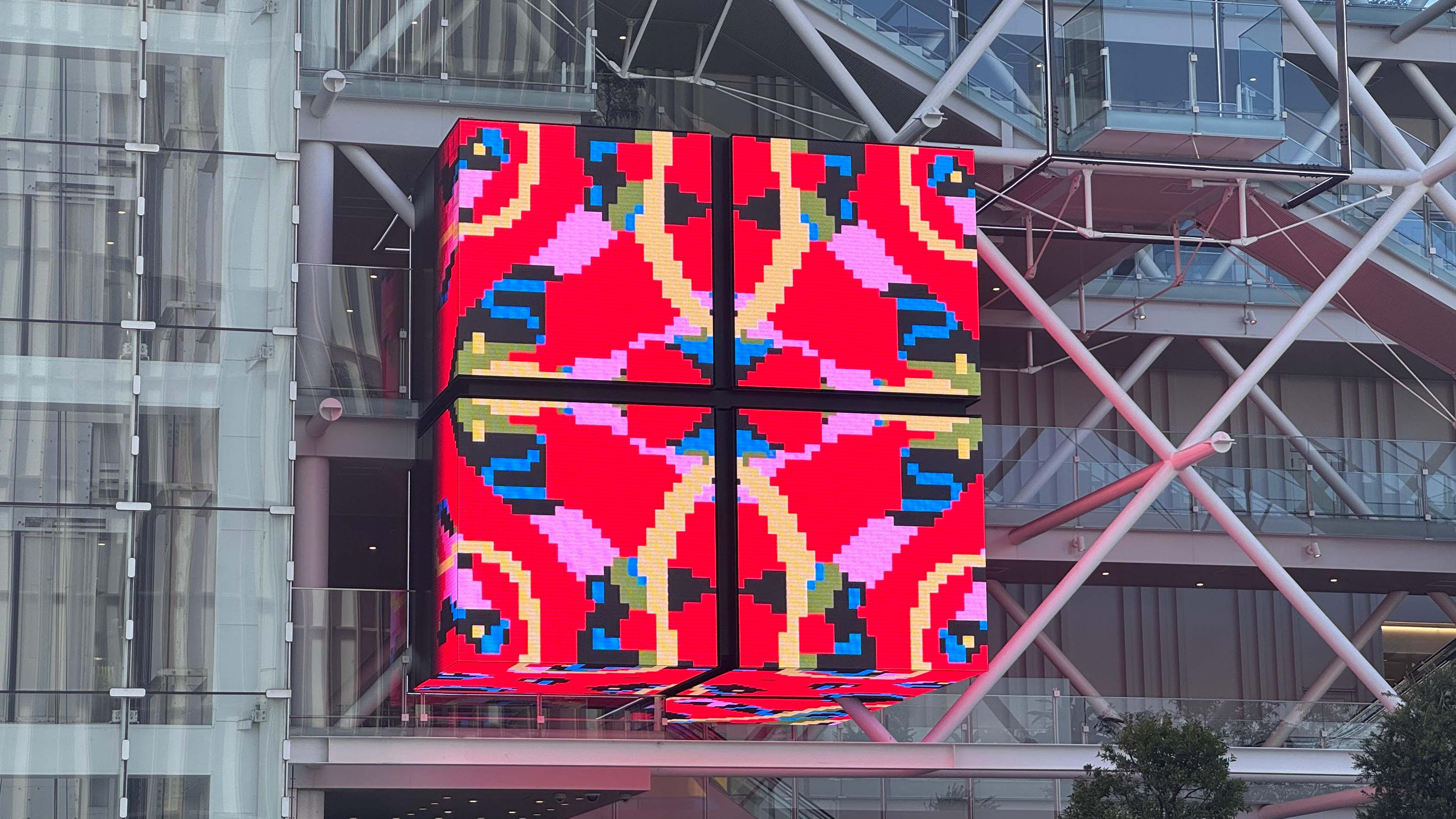
Cubed Landscape is a series in which algorithms inspired by nature are reinterpreted through the ecological elements of the Tama River, arranged and combined within a new physical structure. Adapting an existing visual language to the distinctive structure of the cube — with its central screen divided into four window-like panes — the work is composed so that, viewed from the front, imagery flows in a single direction through three windows, joining into a vast panorama. This flow, connecting organically beyond the physical boundaries of the screens, offers viewers a deep and expansive sense of visual extension, an attempt to open a new "window onto nature" within a familiar urban center. The elements of the work that evoke the birds and fish, grasses and insects of the Tama River gain new vitality through a process of weaving fragmented images into one. As the fragmented screens gather to complete a single vast ecological landscape, the work invites us to see the fragments of nature we have encountered as a world connected once again.
Artist Interview
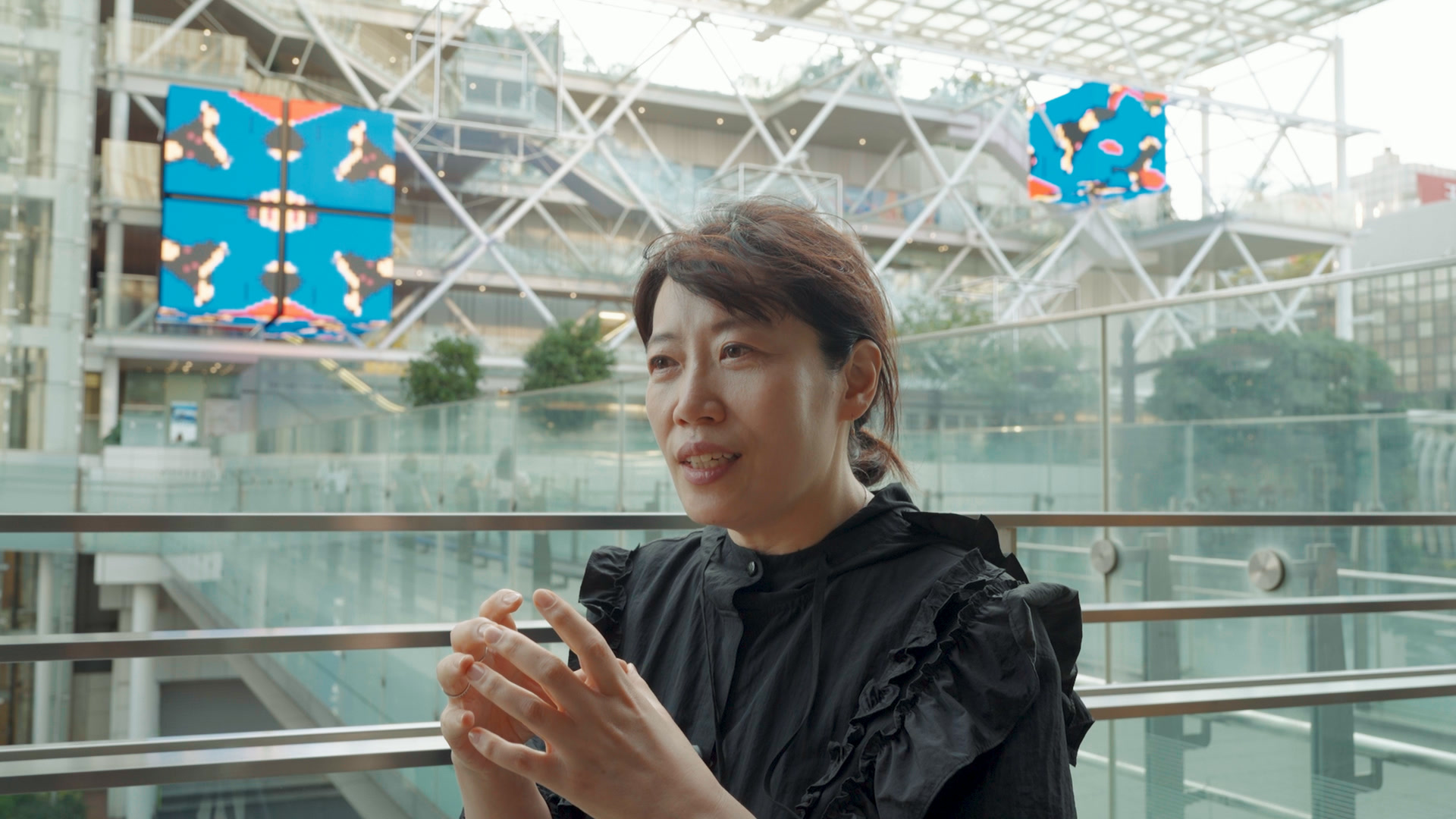
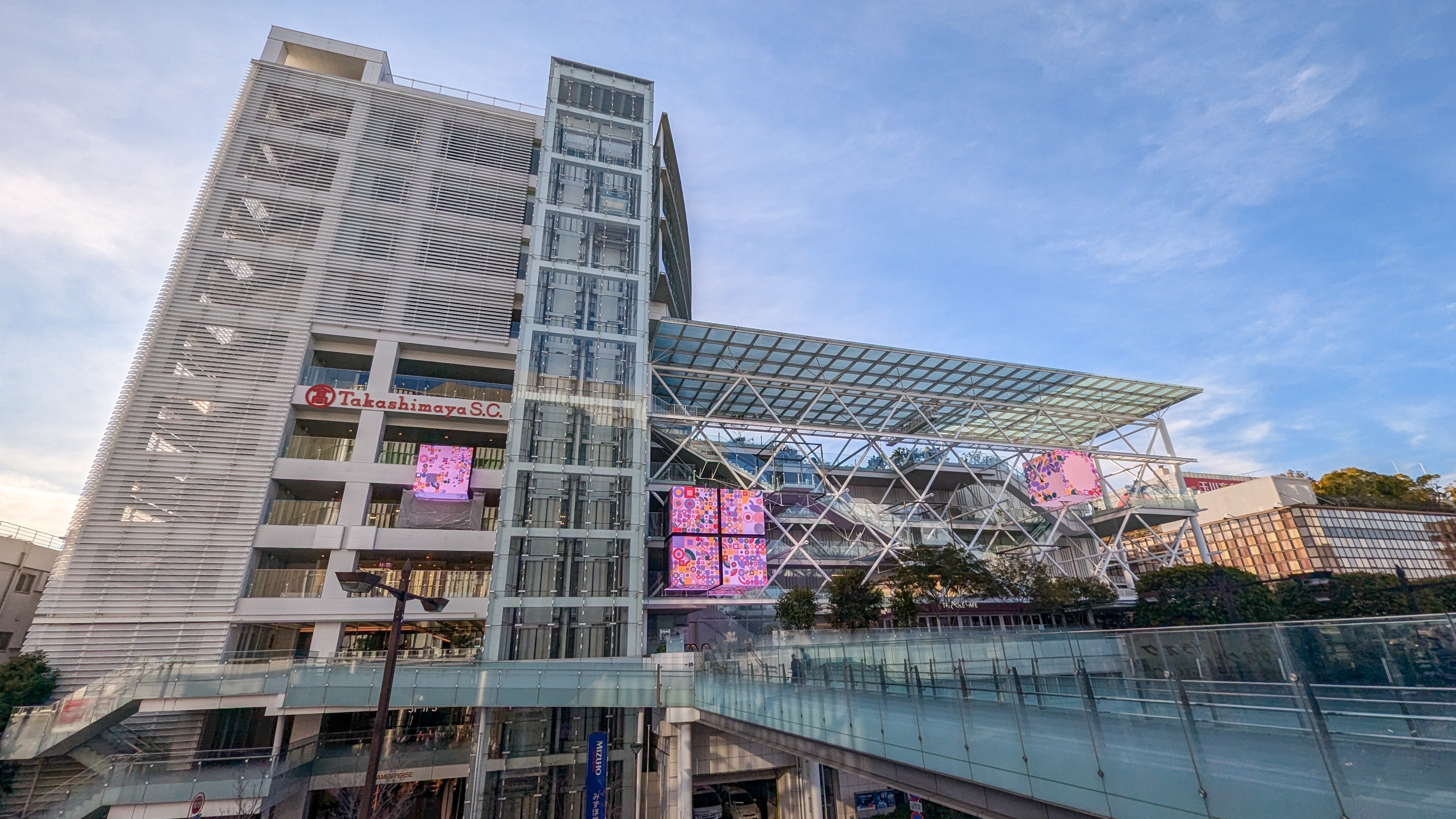
August 19, 2026, Futako-Tamagawa, Tokyo. In front of the LED cube installed on the facade of the South Building of Tamagawa Takashimaya S.C., we spoke with the Korean generative artist SEO. The two works SEO created for this cube, Kaleidoscopic Flare and Cubed Landscape, are video works born from two ideas: a kaleidoscope and a window. The LED cube consists of three large displays installed in March 2025 as part of the building's exterior renewal, showing video works up to six meters square under the concept of "a cube in dialogue with the city." The overall architecture was designed by NOIZ, and the main screen is divided into four panes. SEO began their practice during the pandemic, writing code and posting a new work every day, and now presents work on public screens around the world — in Korea, Singapore, the Netherlands, and the United States. And yet, the day of this interview was the first time SEO had seen the cube in person. Why a kaleidoscope, and why a window? The four-part screen, the parallels with towns on the outskirts of Seoul, and the relationship between the rules of the city and generative art. What did SEO — who has seen screens across the world — see when standing in this place for the first time? We walked and talked amid the sound of passing trains and the wind threading between the buildings.
From Daily Code to the World's Screens
The interview began with SEO's self-introduction.
"I'm SEO, a generative artist from Korea. I started my practice during the pandemic, writing code and posting a work every day, and now I present work on public screens around the world."
Those venues have expanded from Korea to Singapore, the Netherlands, and the United States. In recent years, opportunities to show work in Japan have grown as well — in Shibuya, and in exhibitions organized with NEORT.
"In Japan, LED screens in all kinds of shapes keep appearing. When I see them, I want to take on the challenge myself, so I've been working on all sorts of projects."
Starting from a Screen Divided in Four
Looking up at the six-meter cube, the first topic was how this screen came to be. Most large LED displays in cities are installed as advertising equipment, added onto buildings after completion. For SEO, that is exactly where this place differs.
"Basically, when a building has an LED screen, it's usually there to generate revenue. So it becomes a generic rectangular screen that can show all kinds of ads and videos, and many of them look like they were attached after the building was finished. But the LED here in Nikotama was interesting from the first time I saw it, simply because it takes the form of a cube — and I was also drawn to the fact that the main screen is divided into four. I would imagine, on my own, that maybe someday they'd reach out to me, and I'd think about what kind of work would suit it."
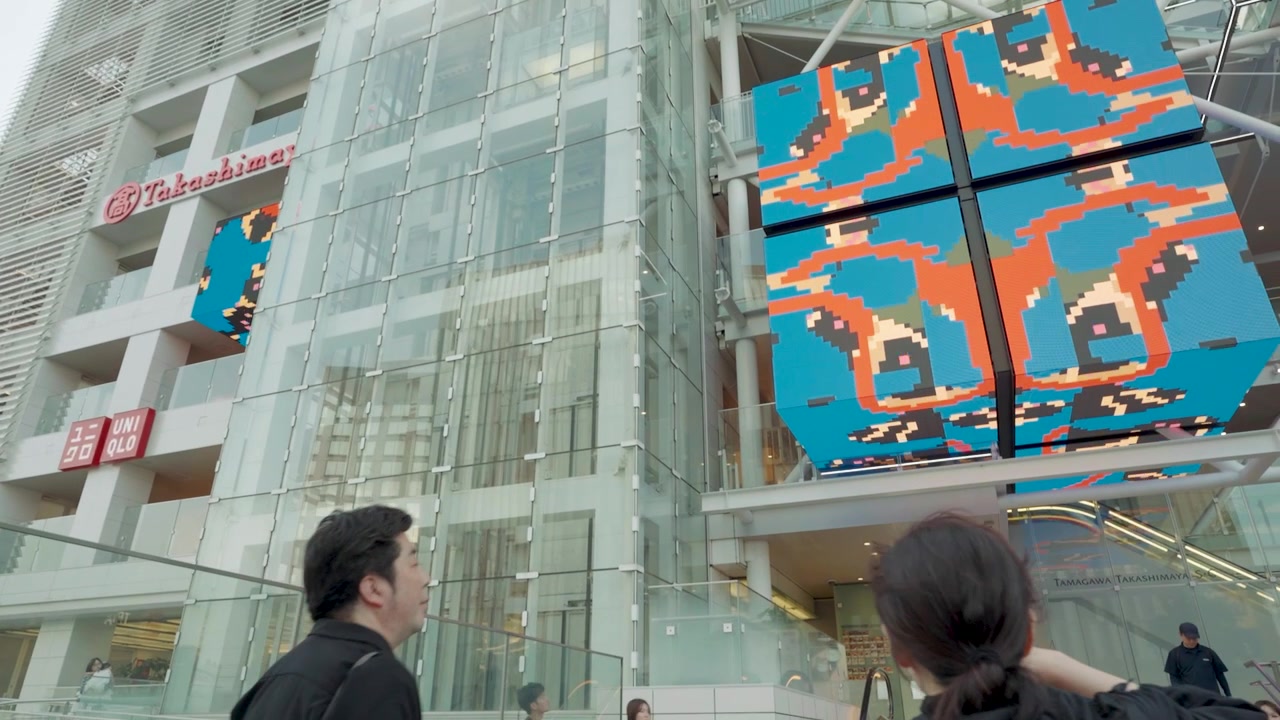
There were also things SEO noticed only after standing on site: the slender members supporting the elevator's glass, the cubic structures built into the stairways. They seemed continuous with the shapes in SEO's own videos.
"When I was looking at it on video, I hadn't noticed that much. But coming here this time, it wasn't just the cube over there — the lines supporting the elevator glass and so on also seemed connected to the rectangles and lines I use in my work. When showing generative art, the screen doesn't look like an isolated, standalone work; it feels like it's speaking in the same voice as the building. I realized that's a really interesting point."
SEO's practice begins by refusing to treat the screen as merely a giant display. For the screen at Shibuya MODI — SEO's first work in Japan — the columns that characterize the building were brought into the composition of the video.
"What I value when making a work is not thinking of the LED screen as a big television. It exists first as part of the architecture, and only that part can change flexibly. I think about what kind of freedom that can give the architecture, and what kind of interesting events it can produce. The screen at Shibuya MODI, where I first presented work in Japan, also had columns that defined the building, so when I made the video I brought those columns into the composition, so that the work would be seen together with the architecture."
A Kaleidoscope, and a Window
From the condition of a screen divided in four, two ideas emerged. One connects to a memory of art class in a Korean elementary school.
"In Korea, in elementary school art class, we had lessons where we'd use ink and make patterns by folding and mirroring. When I saw this screen, it also looked to me like something that folds and reflects, so I made a work in the manner of a kaleidoscope — a single image spreading as its reflections multiply. There are three cubes here, so the idea is that the movement expanding from the center also influences the ones on either side."
The other began from seeing the same four-part screen as a "window." The natural environment SEO learned about while researching the Tamagawa area overlapped with that image.
"The four divided panes also looked to me like a window — a single pane of glass with a cross-shaped muntin set into it. So I wondered what might be visible through this window. When I researched Tamagawa, I learned it has a rich natural environment, and I wanted to bring that into the work too. It's a piece built from images like birds crossing the screen, fish swimming through the river, and plants growing along the banks."
The two series are also opposites in how they relate to the surrounding city.
"I thought about the relationship not just with the building and the screen, but with the surrounding environment. The first work gives a little energy out to its surroundings. The second is the reverse — it brings the surrounding environment into the work. I was also thinking about how the city and this LED can live together."
Speaking about Futako-Tamagawa, SEO drew comparisons with landscapes around Seoul. SEO has visited Japan about a hundred times, but this was a first visit to this town.
"It's inside the city, yet it has something of a suburban atmosphere, and in having rich nature, there are similar places in Seoul. For example, Cheonggyecheon, in the center of the city, is small, but water flows through it, and the surrounding buildings and nature exist together. Then there's an area called Misa. It has Olympic venues, it's a place families go on outings — and there's also a huge shopping mall called Starfield. There's nature, there's sport, there's a shopping mall, there are families and culture. That kind of energy felt a little similar to me."
A Screen You Don't Have to Wait For
When presenting work on urban screens, artists often end up waiting out the advertisements — timing their filming to the brief moment their work appears. SEO has been through this many times.
"Usually, when I show work in cities in other countries, the waiting is just long. The proportion of advertising is high, so I'd often wait for all of it to finish and film the one minute or thirty seconds when my work appeared. But here, the works play continuously, so you can stop and take your time looking. Lots of places put up phrases like 'an art gallery in the city' and show artworks, but in reality it never gets viewed like a gallery — it often turns into a feeling of 'quick, look now.'"
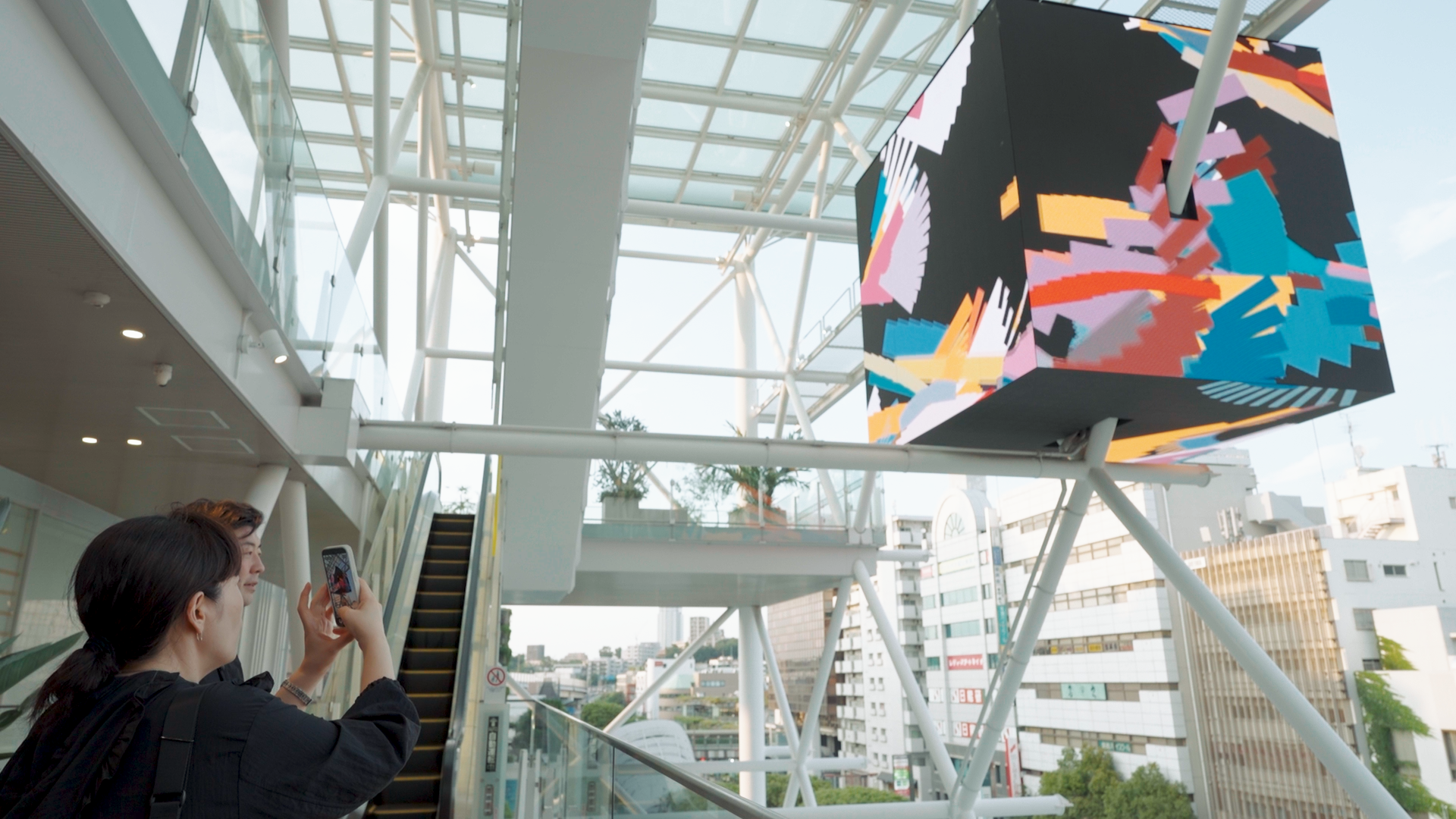
Here, the viewing position isn't fixed either. The interview began directly beneath the cube, moved up the escalators floor by floor, and continued across to the plaza opposite.
"With an ordinary rectangular screen, the viewing position is more or less set, and even if you move, the way it looks doesn't change much. But here you can look from below, look while moving between floors, come in close, look from above and from below — the way it appears changes completely. It feels like appreciating a sculpture while walking, like being in a new type of gallery."
SEO also noted that the screen sits relatively low, sharing the same field of view as the surrounding trees. Large urban displays are, in most cases, mounted high on buildings.
"I thought it was wonderful that here you can see the trees and the screen together. Large screens are usually quite high up, so it's hard to create scenes where they're seen together with trees and nature. But here, many things enter your field of view at once."
Approaching the screen, the image that read as a single picture from a distance comes apart, returning to lines and dots.
"With generative art, the way it looks changes depending on whether you view it from up close or from afar. Pixels are the same — zoom way in and they're just rectangles, but from a distance they look like a figure or some image. What looked like a bird from over there looks, this close, like nothing but moving lines. I find it really interesting how completely the way of seeing changes."
Of the LED pixels exposed at close range, SEO remarked: "They look like a new texture in themselves."
The City's Rules, Brought Outside
On the affinity between generative art and the city, SEO explained it through the word "rules." Both the work and the city move according to a given set of rules.
"I think generative art is an art whose core is making rules. And the city, too, basically runs on rules. Don't cross on red, cross when it turns green — everyone moves by rules like that. When generative art enters that setting, it doesn't just show a picture; it draws out the rules the city already has and makes them visible. I think that's what's interesting about generative art."
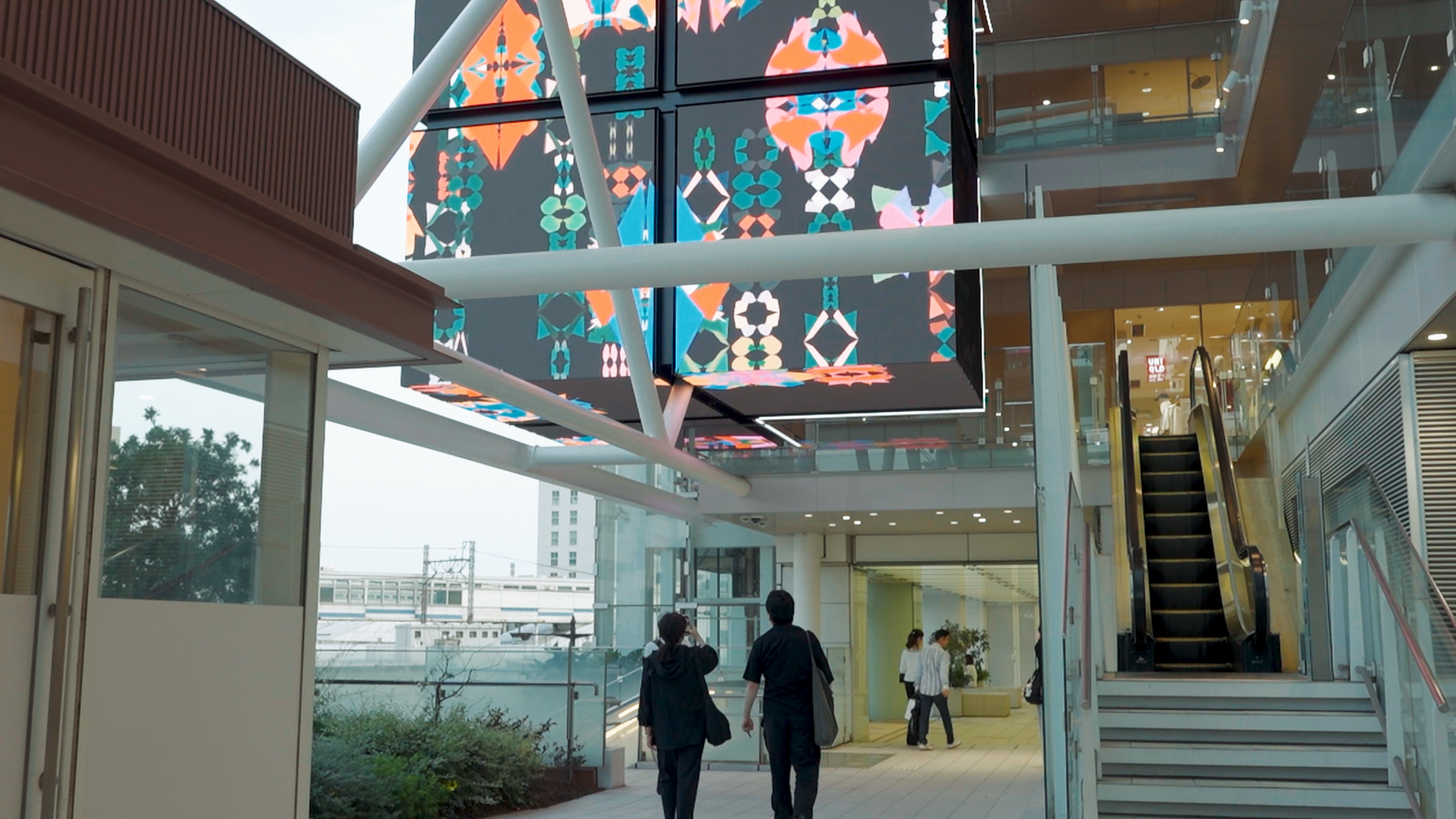
Throughout the interview, wind swept continuously down the main avenue. Cars flowed past, people crossed with the signals, and the wind threaded between them.
"Especially here near the Tama River, when you watch the whole scene, first the cars are moving, and then people cross the signals in a different rhythm. And then the wind passes down this big avenue. The movement of the video you're watching and the strength and feel of the wind on your skin start to connect together with this rectangular screen. It might really be a very good place for seeing generative art."
"If I Had Known, I Would Have Changed It a Little"
What made SEO decide to actually visit this place, they said, was footage of the cube filmed at night.
"When I saw the video shot at night, I thought: I have to go."
Going up to the upper floors, a train passed, and the cube's imagery was reflected in the glass of the building opposite. Seen from the side, the front screen designed as a "window" and the adjacent face enter the field of view at the same time.
"If I had come here before making the work, I think it would have turned out completely different. With the window idea, I made it thinking about how the windows would appear connected — but from the side, you see the neighboring face together with it, and I hadn't realized, while making the work, that this would affect how it's seen. If I had known, I would have changed it a little."
And then SEO added:
"It's architecture you can't understand from photographs alone. It's architecture to be experienced."
Standing at a spot on the plaza looking down at the cube, not only the screens but the people passing beneath them and the surrounding buildings all settle into a single view.
"You can see the objects, you can see the people — everything is visible together. Maybe screens are always watching everyone with this kind of feeling."
Disclosure
This article is based on NEORT's public information and internal records; an AI-written draft was structured and edited by our editorial team.
| Artist | seohyo |
| Space | 玉川髙島屋S.C. LED VISION CUBE |
| Period | 2026.4.3 0:0:0 -2026.9.24 13:0:0 |